Incense & Essential Oils in the Esoteric Tradition: More Than Fragrance
Exploring the traditional and esoteric role of aromatic substances in purification, meditation, healing and ritual.
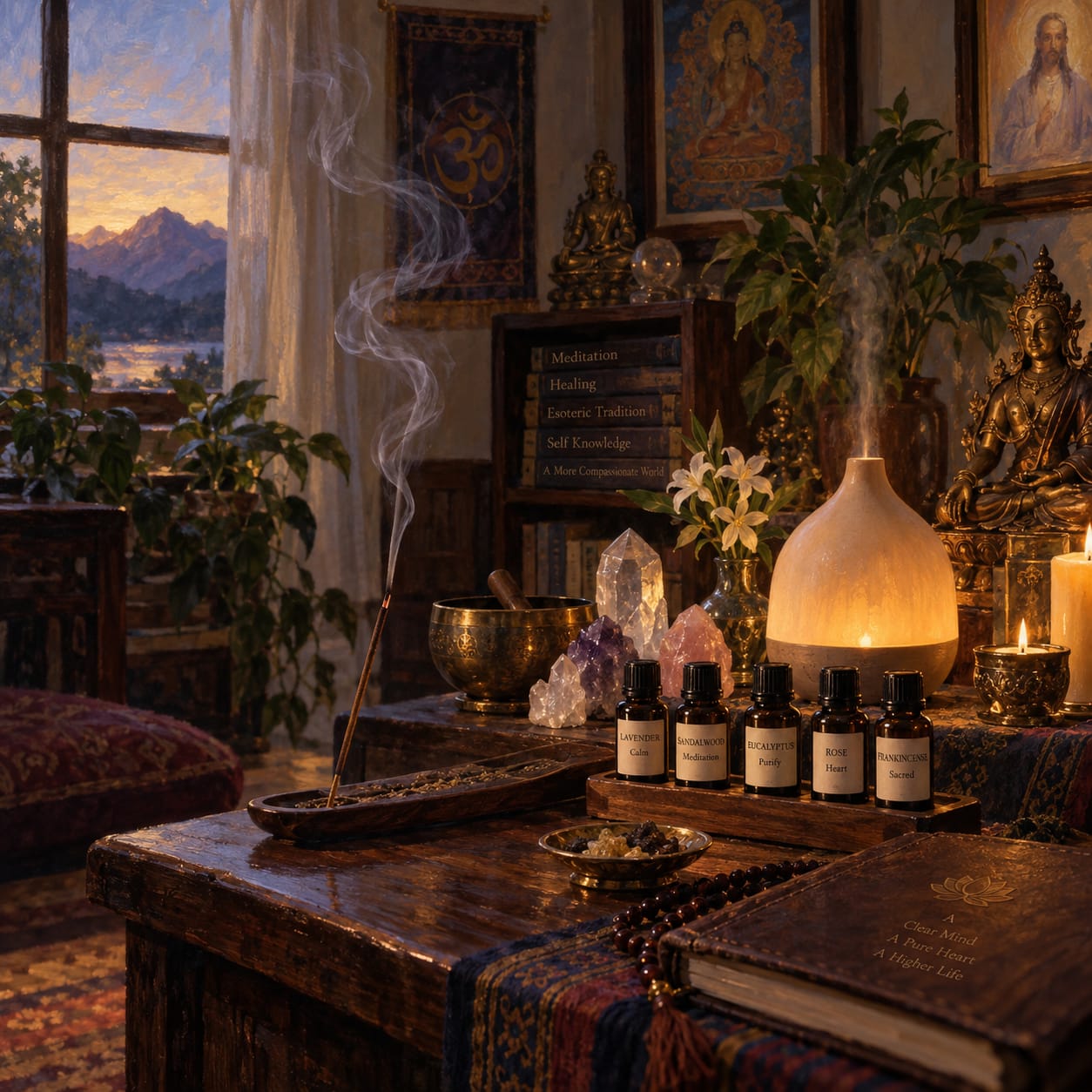
For thousands of years, incense, aromatic resins, herbs, flowers, and fragrant oils have accompanied humanity's spiritual practices. Long before essential oils became associated with modern aromatherapy or incense became something we burned simply because we enjoyed the fragrance, aromatic substances occupied an important place in temples, sanctuaries, healing practices, meditation, and ritual.
The esoteric traditions of both East and West have often attributed a deeper purpose to fragrance. Incense and aromatic oils were regarded not merely as pleasant scents, but as substances capable of influencing the subtle atmosphere surrounding a person or place.
Samael Aun Weor draws attention to the remarkable universality of this practice:
“Incense and perfume burn delightfully in all Hindu, Parsi, Jain, Shinto temples, etc. Incense and perfumes were never absent from the temples of Greece, Rome, Persia, etc.”
— Samael Aun Weor, The Perfect Matrimony
The details differ from one tradition to another, but the principle is remarkably consistent: before sacred work begins, the atmosphere is prepared.
Incense and the Purification of Space
Anyone who has entered a temple filled with the fragrance of sandalwood, frankincense, or another traditional incense knows how dramatically scent can alter one's experience of a place.
From an esoteric perspective, however, purification involves more than removing unpleasant physical smells. Many traditions teach that human emotions and thoughts leave subtle impressions upon our surroundings.
A room in which people continually argue feels different from a meditation hall. A place devoted to prayer for many years may develop a distinctly peaceful atmosphere. Esoteric teachings explain this in terms of subtle energies, thoughtforms, and emotional influences accumulating within a space.
Incense has therefore traditionally been employed as one method of preparing and purifying the environment.
“The devotee must purify his bedroom daily with the smoke of special aromatic substances. Incense purifies the astral body. A good incense attracts the great masters whom we need for our work.”
— Samael Aun Weor, The Perfect Matrimony
“Proper incense is a barrier to the approach of entities and elementals from the underworld.”
— M, Lord God of Truth Within
Whether one interprets such teachings literally, symbolically, or through the traditional occult understanding of the subtle worlds, they demonstrate something important: incense historically had a ritual function.
It was not simply an ancient version of an air freshener.

Incense in Pranic Healing
A similar understanding can be found in the teachings and practices associated with Mahatma Choa Kok Sui, the founder of modern Pranic Healing and Arhatic Yoga.
Within Pranic Healing, cleanliness is understood on both physical and energetic levels. Practices for cleansing rooms and objects consequently form part of the wider system.
Mahatma Choa Kok Sui used incense for purposes such as purifying spaces and in connection with the cleansing and consecration of crystals. Incense thus becomes part of the preparation of an environment or object intended for spiritual or energetic work.
This also helps explain why incense is so commonly found in meditation rooms, healing spaces, temples, and altars throughout the world.
Essential Oils in Esoteric Practice
Incense is only one side of the story.
Aromatic oils also appear in modern and traditional esoteric practices. Essential oils are concentrated aromatic extracts from plants, and different traditions have associated particular plants and fragrances with different qualities.
In the Pranic Healing system, for example, lavender essential oil has been recommended for use in a healing spray bottle. Lavender oil is also used in connection with the salt-water bath practiced for energetic cleansing.
Here the essential oil is not being chosen merely because it smells pleasant. It forms part of a broader system of purification.
Other esoteric teachers have similarly attributed specific subtle properties to different aromatic plants.
Eucalyptus and the Cleansing of Emotional Atmospheres
The Armenian-American esoteric teacher Torkom Saraydarian frequently discussed the relationship between health, consciousness, subtle energies, and one's environment.
One practical recommendation found in his teachings is to place a few drops of eucalyptus essential oil in a cup of boiling water near the bed before sleeping, allowing the eucalyptus aroma to diffuse into the surrounding atmosphere. Saraydarian associated this practice with protection.
In Cornerstone of Health, he gives an even more interesting description of several aromatic substances:
“Sandalwood destroys mental thoughtforms. Eucalyptus destroys emotional thoughtforms. Rose oil is the masterpiece that disintegrates many formations and cleans them.”
— Torkom Saraydarian, Cornerstone of Health
This statement reveals an important distinction within esoteric aromatics.
Different substances were traditionally believed to have different subtle functions.
Sandalwood, for example, has been associated with meditation and spiritual practice throughout Asia. Saraydarian specifically connects it with mental thoughtforms.
Eucalyptus is connected in his teaching with emotional thoughtforms and purification.
Rose, meanwhile, is given an especially important cleansing function.
Rather than treating every pleasant fragrance as interchangeable, the esoteric student therefore learns to select aromatic substances according to the purpose for which they are being used.
Preparing a Space for Meditation
One of the simplest applications of these principles is preparing a meditation room.
Our external surroundings influence our internal state. Before meditation, prayer, healing, or spiritual study, traditional practitioners often deliberately prepared their surroundings.
The room might first be physically cleaned and ventilated. Incense could then be burned, or an appropriate essential oil diffused. The practitioner might subsequently pray, invoke a blessing, chant a mantra, or simply sit quietly before beginning the meditation.
These actions establish a boundary between ordinary activity and spiritual practice.
There is also a psychological dimension to this. When the same fragrance repeatedly accompanies meditation, the mind begins associating that aroma with silence and contemplation. Lighting incense can consequently become a simple ritual telling the mind: the activities of the outer world have ended; the inner work is beginning.
The Importance of Quality
If incense and essential oils are going to form part of spiritual practice, their quality becomes particularly important.
Many inexpensive fragrance products marketed as "incense" or "aroma oils" rely heavily on synthetic perfumes and other additives. A strong smell does not necessarily indicate a high-quality aromatic product.
Traditional incense was generally produced from combinations of naturally aromatic materials—woods, resins, gums, herbs, flowers, spices, and plant extracts.
Likewise, a genuine essential oil should not be confused with a synthetic fragrance oil merely because both smell similar.
This distinction was one of the reasons Prana Essentials was created.
We wanted to make carefully selected incense and essential oils available to people who use aromatic substances not merely to make their homes smell pleasant, but as part of meditation, purification, healing practices, ritual, and spiritual life.
Fragrance as Part of Sacred Life
There is something profound about the fact that civilizations separated by enormous distances arrived at similar practices.
Incense rose from Indian temples. Aromatic substances accompanied the ceremonies of Persia. Fragrance formed part of Greek and Roman religious life. Sandalwood became deeply associated with Asian spirituality. Resins such as frankincense acquired sacred significance across the Middle East and Mediterranean world.
The forms changed, but fragrance repeatedly accompanied humanity's attempt to approach the sacred.
Modern life has largely reduced fragrance to cosmetics, perfumes, room fresheners, and lifestyle products. The esoteric traditions preserve another understanding.
Incense can prepare a space.
Essential oils can accompany purification.
Fragrance can mark the transition from ordinary activity
to meditation and spiritual work.
And perhaps this is the best way to begin the Prana Essentials Journal: by remembering that the incense stick burning quietly beside us belongs to a tradition far older—and considerably more interesting—than we might imagine.
Prana Essentials explores the traditional and esoteric uses of incense, essential oils, aromatic plants, and ritual substances. Our articles are intended for educational and spiritual-study purposes.
Note: Esoteric claims discussed in this article reflect the teachings and traditions cited and should not be interpreted as established medical or scientific claims.